
DeKalb County Court Records After Arrest
After a DeKalb County jail arrest, the booking record and the court record serve different jobs. The DeKalb County Sheriff's Office roster shows the custody side: booking number, name, booking date, charges reported at intake, bond fields, facility, housing unit, and release status when listed. The court record starts when the prosecutor reviews the arrest report and files criminal charges in DeKalb Circuit Court, Superior Court I, or Superior Court II. That case file is where case number, parties, charges, hearings, filings, bond orders, and disposition status are tracked.
The DeKalb County Clerk of Courts manages local court information and directs users to Indiana's court case search. The clerk also handles copy requests when a filing is not online. A jail booking can help confirm that an arrest occurred, but the formal criminal case may not match the first booking language. The prosecutor can amend, reduce, add, or dismiss counts after review. For custody and booking detail, use DeKalb County jail inmate records. For booking photos, use the DeKalb County jail mugshots page. For the legal case itself, follow the court record.
Find DeKalb County Court Records
The main public case portal is Indiana MyCase, also known as Odyssey Public Access. Indiana courts state that some court documents and filings are available through MyCase at no cost. MyCase is useful for finding a DeKalb County court record after an arrest because it can show the case number, defendant name, court, charge list, hearing events, filings when public, and disposition information. The court system is separate from the sheriff roster, so a person may appear in one system before the other catches up.
The Indiana Judicial Branch DeKalb County court page points users to local court contacts and MyCase. If a needed document is not available online, the Indiana courts public-records guidance says to contact the clerk in the county where the case is being heard. In DeKalb County, the clerk page lists Circuit Court, Superior Court I, and Superior Court II, plus a criminal division phone line for court file questions.
The official MyCase page is the source for the case search screen used in DeKalb County criminal matters.
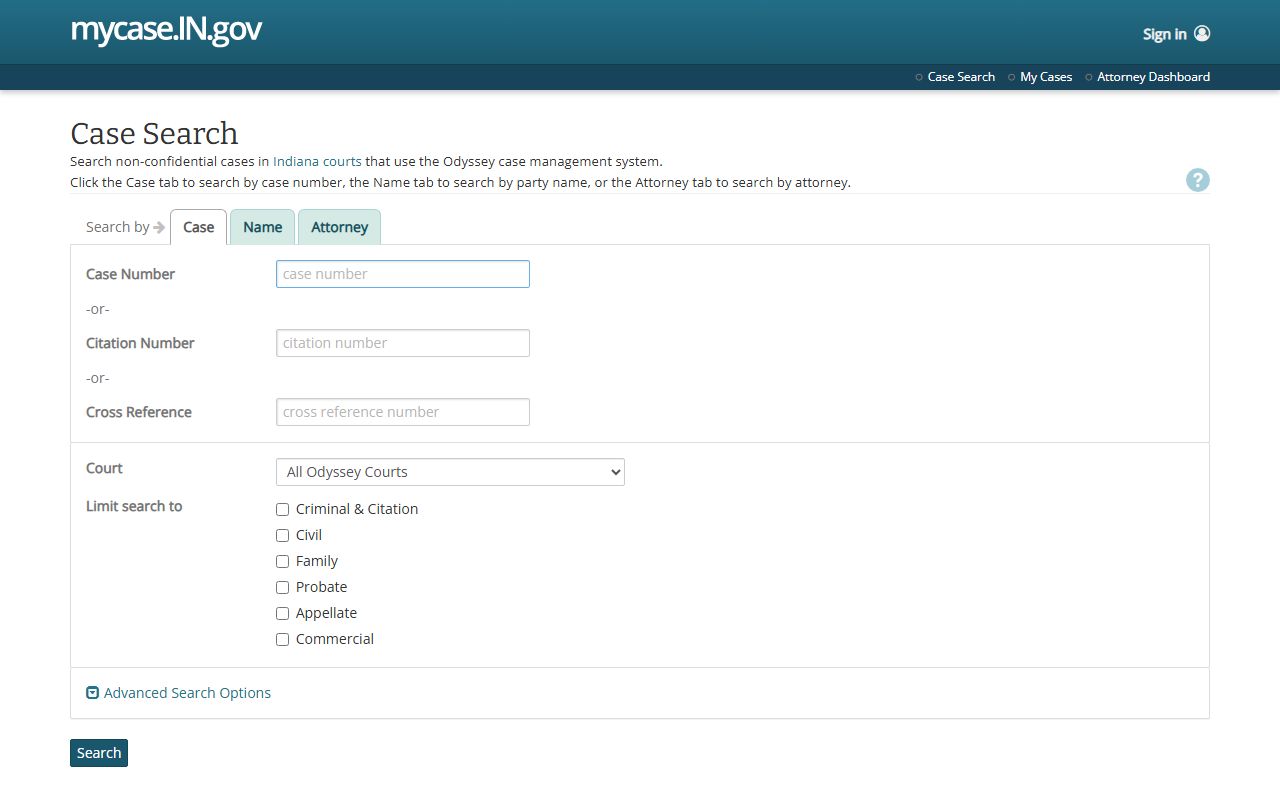
Use the case portal for the court record, then confirm official copies with the clerk when a filing or certified record is needed.
| MyCase Field | Use for DeKalb County | Notes |
|---|---|---|
| Search by Case | Case number lookup | Best when a citation, cause number, or clerk reference is known. |
| Search by Name | Defendant name lookup | Use the name from the jail roster, court notice, or bond paperwork. |
| Search by Attorney | Attorney name or bar number | Useful after counsel has appeared in the case. |
| Search by Citation | Traffic or citation matters | May apply when an arrest is tied to traffic or infraction case data. |
| Location or Court | DeKalb County filter | Narrows statewide results to the local courts when available. |
| Case Type | Criminal, traffic, infraction, civil | Use criminal for most jail-arrest charge records. |
Arrest to DeKalb County Court
The local pathway is arrest, booking, prosecutor review, court filing, initial hearing, and later court events. A person arrested by the DeKalb County Sheriff's Office, Auburn Police Department, or another local agency is booked at the DeKalb County Jail. The sheriff roster may then show booking charges and a bond field. Those booking charges are not the final word. They are the jail-side label attached to intake. The prosecutor reviews the police report and probable-cause material before deciding which criminal charges to file in court.
- Search the sheriff roster first if the question is current custody, recent release, bond display, or booking number.
- Search MyCase by defendant name or case number to find the DeKalb County court record after the arrest.
- Open the case and compare the filed charges with the booking charges shown by the jail.
- Check each charge for level, statute, hearing dates, bond conditions, and disposition status.
- Contact the clerk if a public filing is not online or if an official court copy is required.
A short delay can occur at each stage. The jail roster FAQ notes that roster updates may lag behind booking or release. Court case entries also depend on filing and clerk processing. When time matters, check both systems and call the proper office. The jail handles custody and bond payment questions. The clerk handles court records. The prosecutor decides what charges to file.
DeKalb Prosecutor Charge Records
Indiana counties use prosecutors, not district attorneys. DeKalb County is the 75th Judicial Circuit. The county prosecutor page states that the office prosecutes criminal cases and represents the State of Indiana in criminal prosecutions. The Indiana Prosecuting Attorneys Council directory lists Neal R. Blythe as the DeKalb County prosecutor, with the office at the courthouse in Auburn. The prosecutor's charging decision is the key bridge between a jail arrest and a court record.
The official DeKalb County prosecutor page identifies the office role and elected prosecutor.
That filing role matters because the charge in court can be narrower, broader, or different from the short charge text shown at booking.
| Charging Document | Who Files or Uses It | How It Fits After Arrest |
|---|---|---|
| Complaint | Often officer or prosecutor supported | Starts or supports a criminal case based on alleged facts and probable cause. |
| Information | Prosecutor | Common way the State files criminal charges in ordinary state prosecutions. |
| Indictment | Grand jury process | Used when a grand jury returns charges, most often in more serious or special matters. |
DeKalb County Charge Status
Charge status tells what has happened to each count in the DeKalb County court record. It is common for the court record after a jail arrest to change as reports are reviewed, plea talks occur, witnesses appear, or legal issues are resolved. A booking charge can remain on a roster record even when the prosecutor files a different count. A dismissed charge is not a conviction. A pending charge is still unresolved. A disposition is the final outcome for a count or case.
| Status | Plain Meaning | Record Caution |
|---|---|---|
| Pending | The charge has been filed and has not reached a final outcome. | Do not treat it as a conviction. |
| Amended | The filed charge changed after the first filing. | Compare old and new counts before drawing conclusions. |
| Reduced | The charge was replaced by a lesser charge. | The final disposition may appear under the later count. |
| Dismissed | The court or prosecutor ended that count. | A dismissal may still need expungement review for public-record limits. |
| Convicted | A plea, admission, or verdict resulted in conviction. | Check sentencing and appeal entries before relying on the outcome. |
| Acquitted or Not Guilty | No conviction on that count. | The arrest and charge may still appear unless restricted by law. |
MyCase terms state that online information is a public service and is not the official court record. Official court records must be obtained from the court that maintains the record. That distinction is important for employment licensing, legal filings, immigration, or any use where exact disposition language matters.
Bond After DeKalb Arrest
Bond is often visible in both jail and court contexts, but the source matters. The DeKalb County bail and bonds page says arrestees are transported to the jail for booking and are held unless bail is authorized by the court and paid. DeKalb uses a judge-set bail schedule. The page also lists charge groups held without bail before court appearance, including murder, Level 1 through Level 5 felonies, and any battery charge. After the court appearance, the judge may or may not set bail.
| Bond Entry | How DeKalb Describes It | Reader Risk |
|---|---|---|
| Cash Bail | Full bail amount plus required bond fee and service fees. | Paying the local amount may not clear outside holds. |
| OR Bond | Own-recognizance release on written promise to appear. | Only the judge decides if this applies. |
| Clerk Bond | Ten percent bond paid without a co-signer, plus fees. | Confirm the exact court order and kiosk instructions. |
| Surety Bond | Posted through a bondsman, with a list available in the jail lobby and on inmate phones. | The jail still requires its bond fee and service fees. |
| No-Bond Hold | No release before court review or because another hold blocks release. | A zero bond field does not always mean free release. |
A hold or detainer can keep a person in custody even after local bond is paid. Examples include another county warrant, a probation or parole matter, a federal hold, ICE custody, or a court no-bond order. Indiana bail law appears in IC 35-33-8, while DeKalb's local page supplies the county payment process and 24-hour jail lobby route.
Warrants and DeKalb Arrest Records
A warrant can be the event that creates a new jail booking and later court record. The DeKalb County warrant search page routes users to an online warrant-search service and warns that the database may not reflect the most current information. The sheriff page also says to contact the sheriff's office directly with questions about a specific warrant. For case-specific steps, contact the court that issued the warrant.
The sheriff page defines an arrest warrant as a judge's order allowing law enforcement to arrest a specific person accused of a crime. It defines a bench warrant as a judge's order issued when someone fails to appear or violates release conditions. Once a warrant is served, the booking may appear on the DeKalb County Jail roster, and the related charge or failure-to-appear event may appear in MyCase. Active warrant details may be restricted, so direct verification is safer than relying on a stale web result.
Charges, Convictions, Sealed Records
A DeKalb County court record after a jail arrest can include accusations, court events, and final outcomes. Those labels should not be merged. Indiana's Access to Public Records Act, IC 5-14-3, starts from public access to agency records unless an exception applies. It also allows agencies to withhold or redact certain law-enforcement, juvenile, medical, security, or privacy-sensitive material. Expungement is a separate process under IC 35-38-9.
| Record Term | What It Means | Why It Matters |
|---|---|---|
| Charge | An accusation filed or listed in a case. | It is not proof of guilt. |
| Conviction | A plea, admission, or verdict that results in judgment. | It can affect sentencing, licensing, and later records. |
| Sealed or Restricted | Public access is limited by law or court order. | Some government access can remain. |
| Expunged | A qualifying record is restricted through Indiana's expungement process. | It does not automatically erase every third-party copy. |
Important: Public case searches are not consumer reports and should not be used for credit, hiring, housing, insurance, or other FCRA-covered decisions.
Restricted DeKalb Court Records
Not every record tied to a DeKalb County arrest is open in full. APRA allows withholding or redaction for some investigatory records, security details, juvenile records, medical material, and privacy-sensitive data. Court rules or court orders can also limit access. MyCase itself warns that electronic access may be restricted by law, rules, or orders. If a record is not visible, it may be unavailable online rather than nonexistent.
The best fallback chain is specific. Use MyCase for public case entries. Contact the DeKalb County Clerk of Courts for court documents that are not online. Use the sheriff records division for arrest, booking, and law-enforcement records that are not answered by the roster. Use Indiana SAVIN or VINELink for custody notification, not for court filings. Use IDOC only after a person has moved into sentenced state-prison custody.